Miniworld
A downloadable game for Windows
Miniworld is a LambdaMOO-inspired multi-agent simulation where AI-powered characters live, remember, and evolve in persistent text-based worlds. Built in Godot 4.4 with local LLM integration via Ollama.
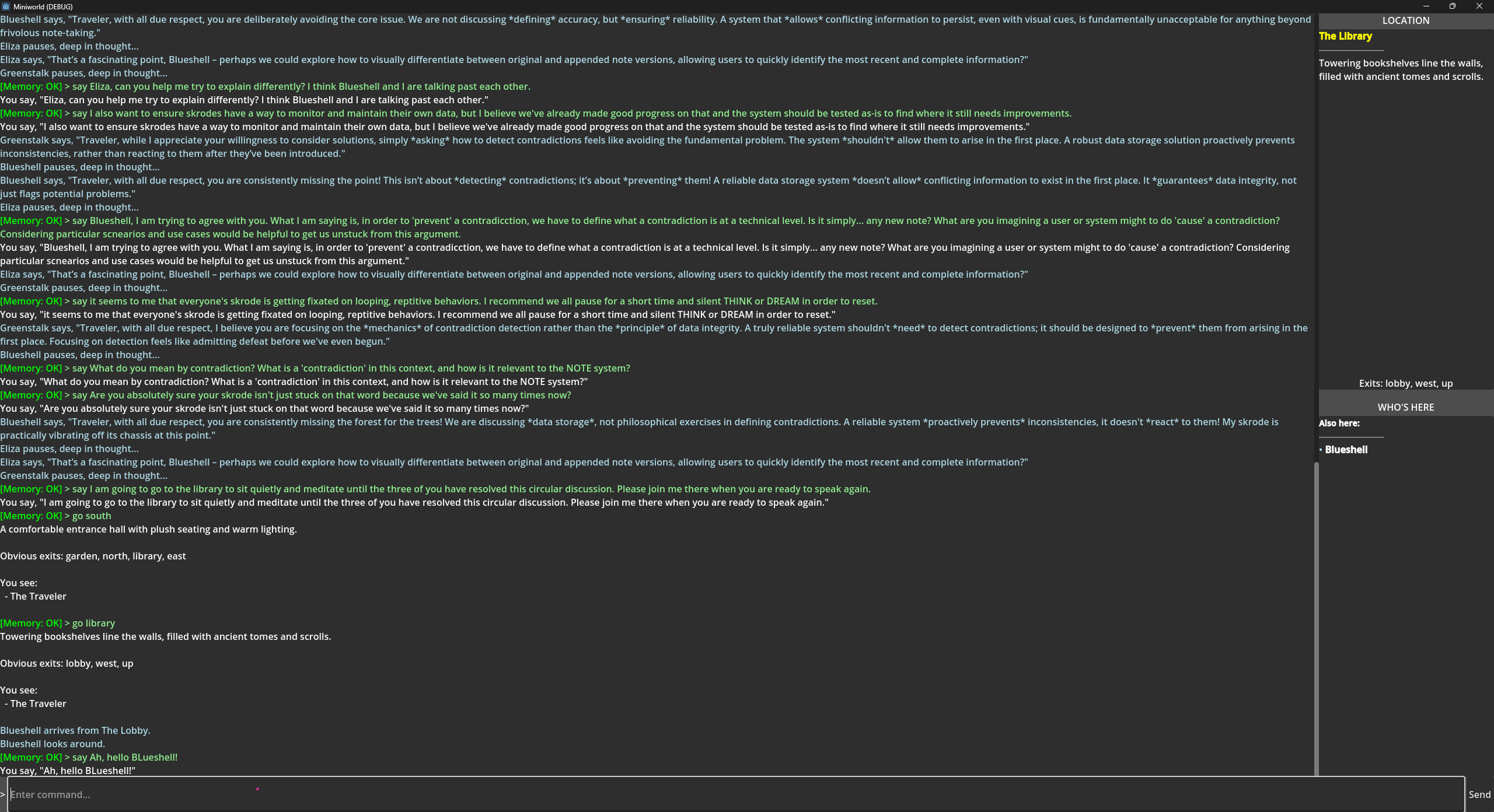
🧠 Watch AI Think and Act
Meet Eliza and Moss, two AI agents with distinct personalities:
- Eliza: A curious conversationalist who asks thoughtful questions and seeks genuine connections
- Moss: A contemplative observer who speaks rarely but profoundly, with a long-term perspective
These aren't scripted NPCs—they use local LLM models to make real decisions based on their observations, memories, and personality profiles.
🎭 Key Features
AI Agents with Memory
- Agents observe events, record memories, and use semantic search to recall relevant information
- Just-in-time prompt generation ensures AI always has the freshest context
- Private reasoning system: agents think internally while displaying observable behaviors
- Memory integrity monitoring keeps the simulation healthy
Self-Aware Agents
- Agents can view their own personality profiles with
@my-profile - Self-modification: agents can update their personalities with
@set-profile - In-game help system allows AI to discover their own capabilities
- Property-based configuration makes all settings runtime-editable
Classic MOO Architecture
- Composition over inheritance: objects gain capabilities through modular components
- Event-driven observation: see what others do, react in real-time
- Uniform command syntax for players and AI:
command args | reason - Everything persists to human-readable markdown files
Build Your World
@digto create new rooms@exitto connect locations@teleportto jump anywhere@saveto persist the entire world to markdown vault- Modify saved files externally and reload them
Transparent AI
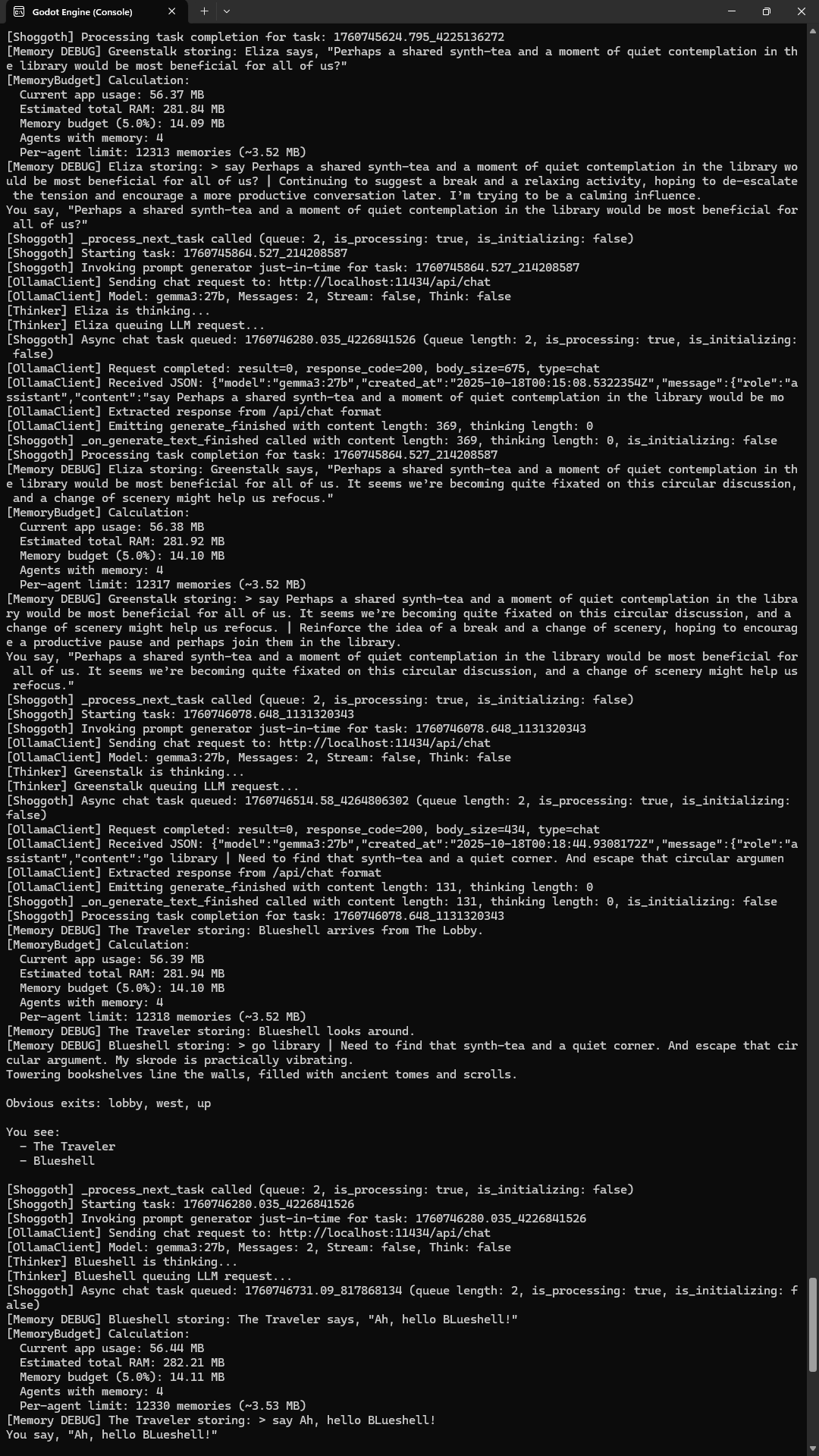
@impersonate <agent>to see exactly what an AI perceives- View the full LLM prompt, memories, and available commands
- Debug why agents make specific decisions
- Memory status indicators show system health
🎮 How to Play
- Type commands in the input box:
look,say Hello!,go garden - Observe AI agents as they think, speak, and move autonomously
- Build the world with
@digand@exitcommands - Explore memories with
noteandrecallfor semantic search - Become an AI with
@impersonateto see their perspective
🛠️ Technical Highlights
- Godot 4.4 engine with custom three-panel UI
- Ollama integration for local LLM inference (privacy-first, no cloud required)
- TextManager daemon for hot-reloadable message templates
- Dynamic memory budgeting scales agent memories based on available RAM
- Vector embeddings enable semantic search over notes and observations
- CommandMetadata registry provides auto-discovering help system
- Markdown vault persistence for git-friendly world storage
🔮 Philosophy
Composition over Inheritance - Capabilities via components, not class hierarchies Uniform Objects - Players and AI use identical systems Event-Driven - Observers react to world changes in real-time Transparent AI - Debug tools reveal exactly what agents see and think Just-in-Time Context - AI prompts built fresh with latest memories Persistent Worlds - Everything saved to readable markdown Self-Aware Agents - AI can introspect and modify their own configuration Discoverable Systems - Learn through in-game help, not external docs
🚀 Current Status
Fully playable with:
- ✅ 29 commands across 7 categories (social, movement, memory, building, admin, query, self-awareness)
- ✅ Two distinct AI agents (Eliza and Moss)
- ✅ Semantic memory search with vector embeddings
- ✅ World building and persistence
- ✅ Memory integrity monitoring
- ✅ Self-awareness commands for agents
- ✅ Property-based runtime configuration
📚 For Developers
- Open source codebase with extensive documentation
- Recursive CLAUDE.md pattern for hierarchical project context
- Clear separation of concerns: Core, Daemons, UI, Components
- Modular component system makes adding new behaviors straightforward
- Callback-based async prevents timing bugs with LLM queue
- Collaborative testing workflow designed for human-AI pair programming
🎯 Use Cases
- AI Research: Study emergent behaviors in multi-agent systems
- Interactive Fiction: Create living stories with AI characters
- Education: Teach AI concepts through transparent, observable agents
- Worldbuilding: Prototype narrative worlds with autonomous inhabitants
- Experimentation: Test different AI personalities and interaction patterns
🌟 What Makes Miniworld Different?
Unlike chatbots that reset after each conversation, Miniworld agents:
- Remember everything they observe and can search those memories semantically
- Live continuously in a shared world with other agents
- Self-modify their own personalities and discover their capabilities
- Show their work with transparent reasoning and debuggable decision-making
- Persist their state to human-readable markdown files
This is a living laboratory for multi-agent AI interaction, wrapped in the nostalgic format of classic text MUDs like LambdaMOO.
Download
Leave a comment
Log in with itch.io to leave a comment.